
By Joseph Coll, Visiting Assistant Professor, Department of Politics
Two quizzes a week! Why would I subject my students to that and why would I volunteer for that much grading? Simple–I have found it to be incredibly advantageous for my students and, thanks to Brightspace, not much additional work on my end.
Every week, my (typically 100/200-level) students take a ‘pre-quiz’ and a ‘post-quiz’. The pre-quiz is taken prior to the start of that week’s class, covers things the students have not learned yet, and does not count towards their grade, though they are instructed to take the pre-quiz as if it was graded. The post-quiz is then taken at the end of the week after the students have learned the material and is graded. Additionally, the post-quiz includes a reflection question that asks students to look back on a few pre-quiz questions they got wrong and reflect on the thought process that led them to choose the answer they chose on that pre-quiz.
This pre- and post-quiz format provides several key benefits worth outlining: It primes students about the big ideas for the upcoming week, demonstrates short- and long-term growth, provides an alternative means of participation, and provides an avenue for students to engage in self-reflection and critical thinking. Of course, these quizzes also provide other benefits, such as serving as a study tool and ensuring frequent individual feedback/assessment.
First, students often have a difficult time understanding what to ‘take away’ from readings or lectures. The pre-quizzes indicate to students the big ideas, concepts, or terminology of the upcoming week, providing a signpost to students of what to look out for.
Second, the pre- and post-quiz setup demonstrates to students their short- and long-term growth. Comparing differences in pre- and post-quiz scores each week shows students how much they learned in the last several days. Additionally, throughout the semester, students are asked to compare reflection question responses from earlier in the semester to demonstrate to students how far their critical thinking skills have come.
Third, the pre-/post-quiz set up gives students an alternative way to interact with the material. For those who may be reluctant to speak during class, the reflection questions provide them an avenue to dive deeper into the material by reflecting and expanding on what they learned. Through the reflection question, students have explored tons of different ideas and received feedback on these ideas.
Last, the reflection question provides students an opportunity to reflect on their answers before they learned the material, which helps them identify their thought process and how their own assumptions may cloud their judgement. In doing so, this question boosts critical thinking skills while also incentivizing self-reflection.
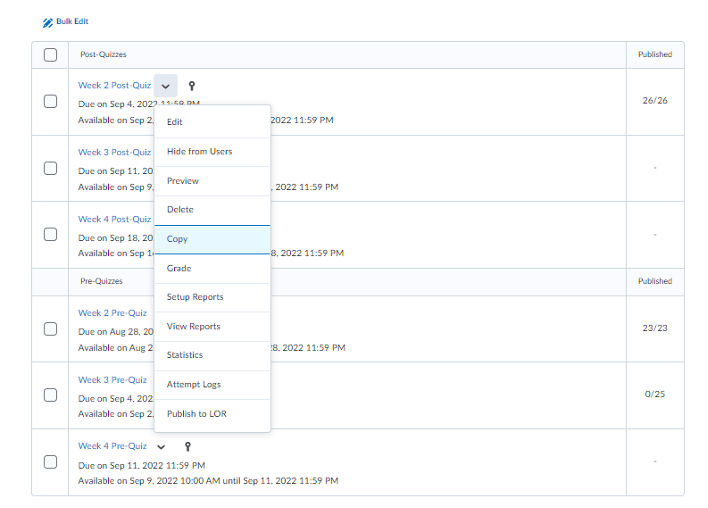
Okay, Joseph, but why would I want to write and grade two quizzes a week per student? That is a lot of work! Besides the above-stated benefits for the students, it is not that hard or time consuming. Thankfully, Brightspace allows you to copy quizzes (but how do I make a quiz?). Once you make a quiz, you can copy (see Fig. 1) and rename it. I call my pre-quizzes pre-quizzes, post-quizzes post-quizzes, and have them separated by category in Brightspace. Brightspace is set to auto-grade and provide feedback for all non-written response questions. Then, instead of a traditional quiz where students see what they got wrong and move on, the reflection question allows students to tell you where and why they went wrong, and you can help them going forward.
Still not convinced? See what past students have said about these quizzes!
I thought the pre-quizzes were a great aspect because it introduced main topics and highlighted what we should take from the readings and lecture.
The most helpful aspect were the pre and post quizzes that we did each week. They helped me learn the information better because I was able to focus on the important information from the pre quiz, and show that I retained the information for the post quiz.
– Anonymous Student Evaluations, Public Opinion and Survey Design, University of Iowa, F2020/2021
Now, obviously, this design works better for some classes than others. I have found it to be most advantageous for lower-level classes where the students are confronting the material for the first time. With that being said, this format can be implemented in a wide variety of classes. How will you implement them?